Friday, 29 January 2021

Conspicuous Compulsion

 CONSPICUOUS COMPULSION

Addiction is a terrible affliction.  In most cases it'll not just harm the addict themselves, sometimes ending their life prematurely, but can often cause huge problems for the people around them, or even to complete strangers.  Clinical addiction is a disease that needs to be treated.

But when we say there's something we "can't do without" we don't usually refer to the kind of chemical dependency that addiction covers.  We mean things that feel as if they make our lives better in some way, be it exercise or chocolate, and there are times when those feelings become near obsessive, compulsions we can't shake off without a sense of having given up.  Over the past year of lockdowns and a life devoid of much in the way of social interaction I've found that having a few obsessions has been not just benign, but beneficial.  So here's four that have made my pandemic life a little bit better, helping to maintain my physical health, mental health, emotional health, and... whatever.

Firstly, with most of our entertainment now online, it would be easy to slip into full on couch potato mode and allow my fitness to decline.  I, like so many people nowadays, wear a step counter on my wrist, set to a target of eleven thousand steps each day.  I could easily accept that, with all the guidance telling me to stay at home and there not being anywhere to go anyway, I should accept that not hitting that target every day is inevitable.  I was forced to when  we were ill and had to self isolate.  But once I was able to get out again, and my fitness gradually came back, I soon regained the habit of wanting to hit my target.  Every day.  With the good weather we had in Spring and Summer it was no problem to get back into it, albeit less so in recent months.  

But I kept going because it's become an obsession.  Each day adds to the streak, and as that grows so does my determination to extend it to 365 consecutive days.  There are times when it becomes more chore than challenge, when it's cold and wet and there's not even a reason to go to the shop.  But I've kept it going, even if it means the hall carpet gets a battering some days, and that a few days ago I only hit the magic 11k figure about 23.45.  Obsession does that. 

My other must-do daily target is writing 750 words into the fittingly named website 750words.com.  That's something I've now done for over 1100 days in a row.  But with so little in my life to write about  it too was becoming a chore.  So I've upped the stakes.  I found a list of 365 (there's that number again) writing prompts, giving a daily suggestion from which to create a story or poem or description or, well, whatever you feel like writing.  I started on the first of January and already it's become an action I MUST undertake.  Each night I look at the next day's subject and start thinking about it.  Each day I am forced to think creatively, so use bits of my brain that might otherwise lie dormant.  The resulting prose and verse has been, shall we say, of inconsistent quality (OK, a lot of it's shite...), but in this case it really is the taking part that's more important than the winning.  

My emotional life is doing just fine, has perhaps even benefited from so much time at home, as Barbara and I have been reminded that we do quite like each other.  But you can't get everything you need from one person, so it's good I have this wee face in my life.


My daily life needs time with Zoe.  Be it as a playmate, a lapcat or a solid lump on my stomach in bed, Zoetime is another must-have.

Which leaves the whatever.  A bit of sweetness.  Most nights, before I go up and brush my teeth, a spoonful (or so...) of chocolate spread seems to find it's way from jar to mouth.  It's like I'm not involved in the process.   

Compulsion, obsession, Pavlovian habit, call it what you will, but it's what helps keep me fit and happy.  What do you do?

Sunday, 24 January 2021

A beautiful mind


Until a few years ago, if you'd said the name Hedy Lamarr to me I'd have vaguely recalled a beautiful Hollywood actress of black and white movie days, and a running gag in Mel Brooks' Blazing Saddles.  Then I listened to the opening track of Findlay Napier's excellent album, VIP : Very Interesting Persons.  The title is 'Hedy Lamarr', the melody memorable, the lyrics simple.  

"You know your place, You're just another pretty face."

"Every time the lights shine down, you disappear"

"If only they'd seen beyond that silver screen."

The sleeve notes hint at the person behind the image, saying she invented the process which became Bluetooth and WiFi.  Clearly there was much, much more to Ms Lamarr than my scanty knowledge even hinted at.  So I did a bit of reading, watched a documentary, and felt sad for the frustrations she must have suffered in her life.

Lamarr, originally Hedwig Kiesler from Vienna, was once touted as the most beautiful woman in the world, a big name Hollywood star who never really got the roles her thespian talents deserved.  She achieved a major success as Delilah to Victor Mature's Sampson in 1949, but was mostly typecast as the femme fatale because of her East European accent and astonishing beauty (and her refusal to have sex with the powerful men who dominated the industry).  As the Napier lyric says, "too beautiful".

Bored with the limited demands acting made on her, she frequently turned to inventing.  Early in World War 2 she and composer George Antheil came up with a radio guidance technology for naval torpedoes that would be impossible for the enemy to jam.  But it wasn't adopted, partly because the  insular military was guilty of not-invented-here syndrome, partly because a (mere) woman was involved in it's origins.   Their invention would eventually be adopted in the fifties, and became the basis for the aforementioned protocols we all use now in our everyday lives.  She and George were finally, posthumously, inducted into the national Inventors Hall of Fame in 2014.

There is so much more to the remarkable Lamarr's life, but those frustrations I mentioned must have a huge influence on the way she saw the world.  Would such a major talent have had greater recognition in today's world?  Hollywood is still misogynistic at times, as the #MeToo revelations have shown, but has still seen huge improvements since the forties and fifties where the stars were so much more closely controlled by the studios.  It isn't hard to imagine Lamarr becoming a much bigger name, and a director, in the twenty first century.  And that the intellectual resources and access to collaborators the internet can provide would have seen her practical imagination and inventiveness able to thrive.  A modern Hedy could find it easier to overcome those frustrations.

Lamarr is largely remembered as a beautiful face, a beautiful body, a beautiful woman.  Findlay and others are doing their bit to have her best known for having a beautiful mind.

Friday, 1 January 2021

Hope in the thaw


OLD GAMMON OR NEW EGGS?

The crows nest, silhouetted against the pale blue above the horizon, still sits firmly perched amid the uppermost branches of the tree before me, a few shrivelled brown leaves clinging to a pretence of a life, no buds yet apparent.  The nest is silent testimony to the industry and construction skills of the birds who built it, and who return year after year to renew their family.  Their time will come.

If I look down I see more green than white now.  There was a moderate snowfall a couple of days ago, covering the graveyard in brightness, setting the gravestones into sharp relief, making them more real and a stronger reminder of the life events behind those monuments to death.  It rained yesterday, the resultant slush then turned into a treacherous low-coefficient topography.  Today only sunshine which, despite the chilled air, steadily removes the watery blanket, only a few stubborn patches of shade putting up a fight.  It's a beautiful day, a day to walk and breathe and enjoy.

It's the First of January.  An arbitrary human marker in the natural flow of the seasons.  A marker of plans and promises, a time of recounting and foretelling.  But who dares make predictions for 2021 after the indecipherable potage that was 2020?  There are few certainties, but that does not mean that we are without hope.  Last night marked the end of one dark saga, our ties to the EU finally snapped after years of lies and bigotry and uncertainty.  The full implications of the Gammon Curtain will be made plain in the coming months.  

But the leaves will return to the naked branches I look out on, the green will flourish and the cemetery adopt it's summer character for yet another cycle of planetary movement.  Diamonds might be forever, but winter, and the gammonist regime, are not.  This was not a direction Scotland chose, but, like the crows, we can rebuild our nest and give birth to something new. 

 The crows will be with us again, there will be eggs, and new life and hungry mouths poking skywards.  They do not need other birds to tell them what to do.  


Thursday, 31 December 2020

We're not going on a summer holiday


SORRY CLIFF, YOU NEED TO CHANGE THE SONG

"We're all going on a summer holiday" sang Cliff Richard in '63.  It wasn't a song to play in 2020.  But was that really so awful?  The idea of the annual holiday away is, in historical terms, a very recent phenomenon

I admit we were lucky, having been able to make trips to Dublin and London, and three times through to Glasgow, for music gigs in January and February.  So I can count those pre lockdown excursions across the city boundary on the fingers of one hand.  And, on the other hand, I can do the same for the rest of the year.  Two of those were brief crossings into East Lothian, when I was practising for Kiltwalk.  Another two went in the other,  a mile or so into West Lothian, to pick fruit on a farm.  And the last one?  That was our summer holiday.

In mid September, on Barbara's birthday, we gave the car a rare outing and headed off to Dunbar - a massive distance of 30 miles...  The sun shone upon us, the sky stayed universally blue, and social distancing was observed by all.  We ate high tea in a courtyard, walked along the harbour, watched the waves hitting the seawall, enjoying the simple pleasure of not being where we were the rest of the time.  Then we drove to North Berwick, sat atop the headland looking out to sea and reading our books.  And home again.


Do I feel short changed?  Not at all.  It was a glorious day, enjoyable for the most obvious of reasons, and as much a provider of fond memories as Lisbon or Rome would have done.  

Nor do I feel hard done by being restricted not just to the city, but to my own locale much of the time.  There's been time to notice new things, explore previously ignored side streets, enjoy this place in a way I might not have done before.  (OK, it helps to be living in one of the most beautiful cities in the world...)  


I sometimes feel bad about thinking this way, and am cognisant of the dangers of sounding smug, because so many people have had such a terrible time in 2020, and that situation looks like continuing deep into the new year.  But if you're fortunate enough not to have been hit by the health and financial and stress problems that the pandemic has dumped on society, then it isn't that hard to adjust your mental horizons to feel no sense of loss at the lack of any new physical ones.  We humans are adaptable creatures after all, it's what makes us such evolutionary successes.   In challenging times we can find surprising ways to meet the challenge.


Thursday, 24 December 2020

Changing times, changing people


THE NEW NORMAL?  WHAT'S NORMAL?

We went on our staff xmas night out a couple of days ago.  By which I mean Barbara and I went for a meal at four in the afternoon.  A pub that couldn't serve alcohol (which is something I find no longer bothers me in the slightest), only one other couple in the place, at the other end of the room, but friendly (masked) staff, a cosy fire near by, and good food.  Our xmas meal was haddock and chips, followed by sticky toffee pudding.  Because this is 2020.

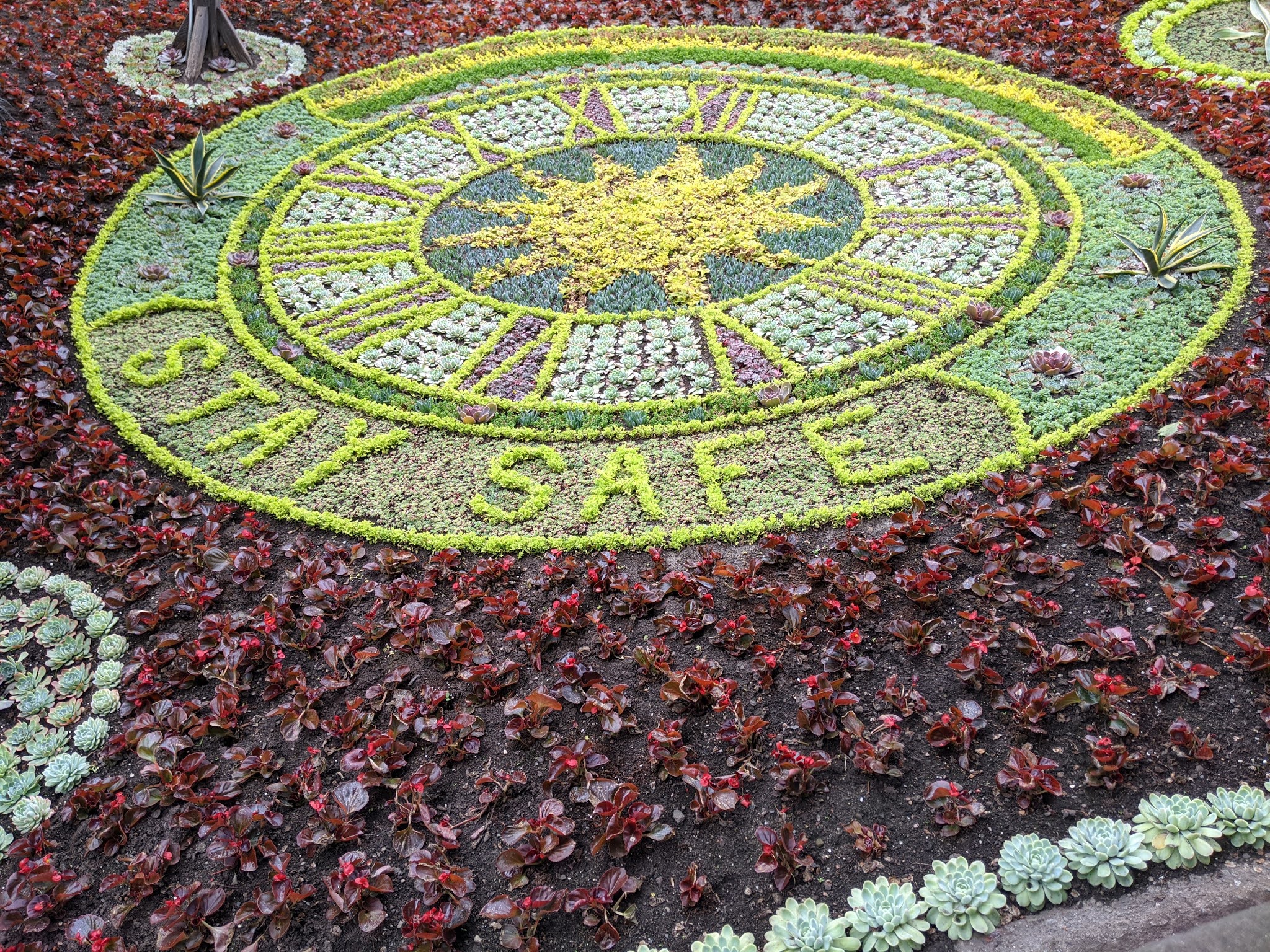
We enjoyed it.  The absence of other people in these times is a lot more relaxing than a room full of potential virus carriers, the lack of 'atmosphere' an attraction more than a turn off.  Stay Safe remains the overriding dictum.  Sometimes it's already hard to remember what it was like in the olden times, before face masks became the latest fashion must-have.  

We used to go out a lot.  Music and comedy gigs, plays, sports events.  Edinburgh's festival, from April to August, were what we did, part of who other people knew us to be.  Now we're a stay-at-home couple, sharing the sofa night after night, looking out on 'our' graveyard and staying well away from the world.  Of the few live events we've been to this year, all bar one were in the pre-lockdown days, and that one brought it's own weirdness.  

At the end of August Edinburgh Rugby were allowed, as a government endorsed experiment, to play a match in front of a socially distanced crowd, for which I was lucky enough to get a couple of tickets.  The careful measures in place came as no surprise, and a few hundred people in a 67,000 seater stadium didn't generate much noise, but it was interesting to see the thinking behind it all working out in practice.  Although that wasn't the weirdest part, not for me.  That came when we left and I realised we were going home in the dark.  I hadn't once gone home in the dark since mid March.

We know (or think we know?) that at some point in the future we'll all return to life that's a bit more like what we remember from pre-covid times.  Not exactly the same, because more home working and online shopping and entertainment are with us now and won't entirely be reversed.   And not forgetting, despite Doris trumpeting his fabled deal today, that brexshit is going to bring its own damage and shifts in our ways of life.  But there will be a time when going for a meal or a drink or to see various forms of live entertainment will return as part of our collective experiences.  That, personally, I can go back to watching musicians and comedians and actors and rugby players doing their thing for my amusement and diversion.  

But will I?  In 2019 I went to 112 live events.  In 2020 it's been just 14. Just as our society has been changed by the last nine months, so have I.  We already know that we don't, can't, fully understand the long term alterations in our lives as a community.  I don't think we know how it's changed as people either.  I certainly don't know what it's done to me.  Will I go back to being that person that goes to all those shows and games?  Will I ever again rush around in August doing 40+ Fringe shows?   

2020 has been a year where we've been forced to learn a lot about ourselves.  I don't think 2021 is going to be any different.

Friday, 18 December 2020

Me an' my ol' rockin' chair

 ARE YOU SITTING COMFORTABLY?


This is my rocking chair.  It's made by Ercol.

My mother had a big thing about Ercol furniture in the 50s and 60s.  So we had Ercol dining furniture.  Four chairs that were reasonably comfy and practical.  And a two seater bench-like thing that was marketed as 'love seat'.  I'm not sure who loved it.  It was a bugger of a thing to get close enough to the table to eat when there were two of you on it.  

Then there was the long Ercol coffee table, and a nest of three wee tables.  And, by far the worst of the breed, the Ercol sofa, which we had from before I can remember until I sold it after my parents died.  It and the coffee table and the nest all went on eBay and the sofa fetched what I thought at the time was a surprisingly good price.  (Although nowhere near what's being asked for this very similar looking one!)  It was bought by a couple in their seventies who drove their old Volvo estate all the way up from Hertfordshire to collect it.  The woman immediately told me when and where it has been made, and all kinds of other information I hadn't asked for.  Something of an Ercol obsessive.  I helped them get it strapped into their roof rack and bid them a safe journey.  Before they left I did remark that I'd never found it to be very comfortable.  She said "Oh they're not, they're terrible.  I always get backache from them."  And then they left.  I have no answer to the obvious question...

The 'love seat' went to my mother's oldest friend.  We kept the dining chairs for a few years, matched with a surprisingly cheap Ercol table we got on eBay, then sold the lot when we moved up to Edinburgh permanently and did a proper bit of downsizing.  Which left one just Ercol item from that inherited collection.

In the late sixties my parents got themselves comfy new armchairs (not from the big E), while if I wanted to sit with them to watch telly my choices were the floor or that bloody sofa.  Quite why it remained with them for five decades I've never understood.  So I moaned about this situation.  (I know, hard to imagine me as a moany child, eh?)  And moaned some more.  And they took me out to buy a chair that would be mine.  Guess which range of furniture the chosen shop specialised in?

But I was happy with the end result.  Mum got her Ercol, I got a rocking chair.  And, despite the thinly padded back cushion, it was very comfy, at least to someone slightly built like myself, and it has remained so.  I loved it and happily spent much of my teenage years there, rocking away watching TV, reading books, listening to music.  When I'd later return to visit as an adult it was always there, in the same spot, waiting for me.  Although once married I had to share it with my spouse - neither of us could tolerate the dread three seater for too long.

So it's the one item from my childhood home I retain a sentimental attraction to.  New cushion covers had replaced the stripey material it had come with.  In recent years we had new sponge cushions cut to replace the crumbling, sagging originals.  And now it sits beside my bedside cabinet.  It's in an awkward spot, makes getting into the wardrobe a more contortionist act than it need be, and hasn't much functional use.  But sometimes I sit there to read a book and I'm home again.  A rocking time machine.

Friday, 4 December 2020

Introducing.... Thundersnow!


NEITHER FLEMING NOR ASIMOV

Thundersnow.  It sounds like something from a fantasy thriller or a sci fi novel, but turns out to be a real thing.  I know because we had it last night.  

It's not a phenomenon that many people outside of the meteorological world were aware of, so it was a rare enough event that Edinburgh made the headlines on the BBC Radio 4 news bulletin this morning.  And Police Scotland found themselves faced with a couple of hundred people wanting to know about the 'explosions'...

I can understand the confusion.  The first lightning flash must have lit up our bedroom enough to half-waken me, the noise that immediately followed was more than loud enough to suggest something unnatural taking place.  Barbara, being on the same side as the open window, probably woke quicker than I did, and had no doubt it was just thunder and lightning, albeit of an unusual volume.  For me, a second behind in fully coming to, the image of a bomb or a gas explosion formed in my mind briefly.  

It was bitterly cold so she got up to close the window, just as the second one arrived.  Big flash, brightly monochromed walls, a fraction of a second pause, and BANG.  No doubt in my mind this time that it was 'just' something I'd seen many times before, just a lot closer and a lot grander.  But I can see How anyone who didn't fully waken in that short time period would have thought the worst.  

So we went back to sleep, found we (well, our city) was in the news when we woke up, and suffered a major let down.  Where's all that nice white stuff to make 'our' graveyard look pretty?  Instead there's rain and wind and a gloom inducing greyness that forces the lights to be on at midday.  Thundersnow should have stayed in the fictional realm, it's too disappointing in real life.  

So maybe it's a fitting event for 2020.  My favourite reaction came from a comedian friend (the wonderful Elaine Miller)who said she and her husband lay there debating whether to gather up the kids and flee Thor's wrath, or sacrifice one of them to appease him.  I mean, if the apocalypse arrived before New year, would any of us really be surprised?

Here's a link to the reaction from that well known source of calm and measured reflection, Edinburgh Live 😉 , but if you search for 'edinburgh thundersnow' there are plenty of more intelligent explanations out there...

Tuesday, 3 November 2020

America or Gilead?


ATWOOD'S WARNING

If you read one of Ian Rankin's most famous series of novels what does Rebus look like in your head?  Chances are, if you've watched many of the TV programmes, it's Ken Stott's face that you see chasing Edinburgh's criminals.  Fair enough, for Rankin doesn't provide many clues to the inspector's physical appearance.  Except that he's at least six or more inches taller than the actor who's become so synonymous with the role.  But overcoming the visual image from screen is, for most of us, hard to do.

It's the same with Wallander books, although there it depends if you're a fan of Sweden's Henriksson or Ireland's Branagh (I'm in the Krister camp).  And if you read any Sherlock Holmes tales the choice of screen faces you can 'use' is near endless (Jeremy Brett for me).  My point being that for most of us the visual image is hard to overcome, no matter what the page says, no matter that the written character is usually the original.

I've just finished rereading Margaret Atwood's The Handmaid's Tale after a gap of more than twenty years.  Maybe even thirty.  But in recent years I've watched the three TV series based on and derived from the book, the fictional Gilead turned into images that had existed only in my imagination before.  I was prompted to return to the original text because I'm now reading Atwood's long awaited follow-up, The Testaments, and it seemed sensible to re-immerse myself in that world, one that inevitably had some differences from the one I'd seen more recently.

In fact the differences aren't all that great, the first TV series staying fairly faithful to the original storyline and the culture it described.  The most striking exceptions being, you've guessed it, the descriptions of the characters versus their appearance on the screen.  Top of that list being Fred and Serena Joy who are far from the beautiful people we saw in Fiennes and Strahovski.  These things matter when they can affect the dynamics of the relationships being portrayed.  

I got through the book in a couple of days.  Still as riveting, thought provoking and frightening as it was.  No, make that more frightening, for this is 2020.  Reading that book now is a different experience from my first experience of it those decades ago.  For three main reasons.

One I've already mentioned.  Being faithful to the author meant trying to ditch the TV faces, forming my own pictures of the protagonists.

And I was back into a familiar world, with no need to try and begin understanding the Gileadian societal roles and hierarchy.  That first reading has always retained a powerful impact, back up by the Elisabeth Moss shows, so there was no need to puzzle over the Handmaids and Marthas and Aunts and Wives and Commanders and Guardians and Eyes and all the other narrowly defined constrictions of that brutalised country.  Although it was interesting to be reminded of how fundamentally racist the author's Gilead is, something there's less stress on in the TV series, where it's the patriarchal and fascistic elements that dominate.

Finally, the times we live in.  Tomorrow, and perhaps in the next couple of months, we'll all be watching to see how robust US democracy is.  Have enough Americans recognised what a monster they have in the White House?  Aren't the totalitarian instincts of the orange manbaby clear enough?  One of the clear lessons of Atwood's theocracy is how easy it is for democracy to slip away, bit by bit, until finally it's no longer there.  I'm voraciously consuming The Testaments now and it clearly shows how people can be manipulated into supporting the new regime.  Succumbing to fascism is a banal process, and many of the most brutal functionaries of the regime are not the ideologues, but the conscientious citizens who think that doing their 'duty' to their country overrides any moral qualms (a theme portrayed even more powerfully in the newer book).  Trump's America is already a far more racist and misogynistic place than it was four years ago.  Where would another four years of the same take them to?  The steps to Gilead are there to see.

And in the UK?  Ever since we were forced to swallow The Fairytale of Barnard Castle it's clear there's some kind of hard right coup in process.  If even the suggestion of someone like Dacre at Ofcom doesn't ring your alarm bells then maybe you're not paying enough attention.  It won't get too serious with Doris, who's only concerned about himself and already looks like he's had enough of a game he's found he's not very good at.  But the possibility of bespectacled slug Gove taking over is a more alarming direction of travel.  And yet another reason why Scotland needs out of this broken state asap.

Footnote - The dominant aspect of Gilead is the patriarchy, the total subjugation of women.  So I wanted to make sure I put women first in this post.  With one exception.  I wrote 'Fred and Serena Joy', not the other way round.  Why?  Because when I say it in my head it simply sounds better, rolls out more naturally.  In the same way that 'Diane and Bartholomew' works best.  And that matters too.  Gilead suppresses almost all forms of art, knowing that art is the enemy of tyranny.  So I'll stick with putting Fred first on this occasion, because art should always trump (sorry...) ideology.  Art reaches the humanity in us, it's about thinking for ourselves, about sharing, about imagination.  Art is the anti-Gilead.

Please, please, please let it be Biden....

Saturday, 31 October 2020

Living, not waiting


THE END OF WAITING FOR THE END


We've got into the habit of watching an episode of some old sitcom while we eat our dinner. Not sure if laughing helps the digestion or not, but maybe it takes the mind off some of my poorer culinary efforts and allows them to seem more palatable.


This daily routine has led to us working our way through series after series of several comedies from the past, including Ab Fab and Dinnerladies. The latest one to be polished off was Waiting For God. Five series and two xmas specials. Originally broadcast in the early nineties, it hasn't dated too badly - what's changed most is the person watching them.


For those who don't know, the series is set in Bayview Retirement Village, a place where older people come to live out their so-called twilight years and await the inevitable end.  There's a lot of funerals. The central characters are Tom and Diana, who find themselves next door neighbours, and the plot revolves around the development of their relationship and how they take on the world around them.


Tom is an ex-accountant, who's lived a mostly boring life and now compensates by indulging in elaborate fantasies. So he's frequently off climbing Everest or escaping from Colditz, without leaving the comfort of his own conservatory. He is cheerful, optimistic, positive.


Diana is ... not. She's had an exciting life as an international photo journalist and now, without that role to give meaning to her life, is waiting to die.  But while she's still around she delights in making life miserable for all around her. She is abusive, curmudgeonly, negative.


This unlikely pair gradually form an alliance (which will later turn into a sexual and, eventually, romantic relationship) to take on the injustices they see around them, mostly to do with the manager of Bayview, the egotistical and materialistic Harvey Bains. The couple are frequently battling to prevent some money grubbing scheme of Bains, or making his life generally unpleasant. In return he is always looking for ways he might be rid of them, especially Diana.


Add in a few other interesting characters (notably Basil, the octogenarian sex machine) and sub plots, and the series had enough to maintain itself across those five series without too often suffering a dip in quality, largely due to the excellent performances of Graham Crowden and Stephanie Cole as the troublemaking oldies. It made me laugh, which is what you ask for most from the genre.


When it was originally broadcast I was in my late thirties. I enjoyed it then, or I wouldn't have wanted to revisit. At the time it made a change to see older people being portrayed as strong central characters, the people with decency, while those of my generation were frequently idiots, deceitful and venal, generally lacking in understanding of what they themselves would become one day (if they were lucky).


But now I'm viewing from a different perspective.  While I hope it's a while before I find myself in any sort of retirement/care home environment (although we can never say what the future holds, as this year has sharply demonstrated), but I'm certainly a lot nearer to that stage of my life than I was thirty years ago.


Now I can view Tom and Diana as role models, for Tom's optimism and determination to enjoy life, and Diana's bloodymindedness and refusal to accept the conventional societal role of 'oldie'. Isn’t it essential that I do, for what's the alternative?  A mix of the fictional Tom and Diana seems a decent template for getting on with retirement. Have adventures, be daft, push yourself a bit, push others a lot more, and stand up to the bastards in life - especially the ones who think the old should be sidelined (although it's hard to blame younger people getting angry when you see how so many of my generation selfishly voted in the two referendums). I'm not going to hang around for anyone's god, but I will enjoy myself.

Thursday, 15 October 2020

2020 - the time of the god of small things


A CHIP IN TIME

I've not posted in here much recently because... there's not a lot going on, is there?  That applies all the more so to Go Live, my other blog where I write wee reviews of gigs, plays and films I've been to.  This year there have been only 11 posts, the last one in mid March.  In 2019 there were nearly 130.  The bulk of those were written during Edinburgh's festival season, from April to August, a stream flowing with music and film and drama and comedy.  

But 2020 is festival-less.  No crowds, no queuing, no being packed into small obscure venues, no timetable to keep to and no piles of tickets to work through.  

I've missed it, but in the bigger picture it barely registers.  There is more to life.  I'm certainly not complaining, for the need for this situation is obvious, and I've settled into a different way of living which is none the less pleasurable for these enforced changes.  I even, as I wrote here a few weeks ago, found plenty to enjoy about lockdown.  But it does require a change of perspective.  Live entertainment provided so many of the real highs of my year.  And a few of the lows - if you take an eclectic approach to festival-going you're always going to find yourself watching films and comedians that are, in the local vernacular, a load o' pish.  But covid-19 has required some recalibration.  The summits and valleys of daily experience exist in a more East Anglian landscape, where the highs are lower and the lows are higher.  You have to look harder for moments to get excited about.

A few days ago, in a moment of clumsiness, I chipped one of our dinner plates.  Of course I was annoyed with myself for doing something so stupid, and for spoiling the set.  A bit of a low point in a day, like most days, where nothing much was going to happen.  And a high point too. A very very low high point maybe, but a high nonetheless.  Because it was something different to talk about, something unexpected, something out of the usual settled pattern, something that provided a couple of minutes of conversation that wasn't about shopping or eating or TV or what bastards the tories are.   I look to the small things to keep me going...