Showing posts with label Art. Show all posts

Thursday, 9 July 2026

The reality of the fiction


LUIGI'S COFFEE

In my previous post I talked about looking in Naples for sites linked to the TV crime drama series we'd been watching, Inspector Ricciardi. On the first night we wandered down to the coast, and saw several of the places we'd seen mention of.

The shot above isn't an exact match for that used in that post from a from last month, but it's roughly the same location. There were too many tourists about (including us!) to get the perfect copy. We also saw the Teatro di San Carlo, the opera house shown in the other photo used there. But we didn't go inside, and the exterior is not so photogenic. There were several other locations too, but there's just one I want to talk about.

I'm not sure if it was in every episode, but it was in most. The Gran Caffè Gambrinus was a regular meeting place for the Inspector and his colleagues and acquaintances. An elegant mid 19th century coffee house, which was frequented, on the screen, by the city's wealthier citizens. It's still very much there, still elegant, even if the clientele is often less so (including us!).


The interior is beautiful, the staff smartly dressed and attentive. It feels like a place where the prices wouldbe, should be, high. So it was a surprise to see how reasonable the dishes we selected for lunch were. I had the special salad, and it lived up to the name. Varied leaves, tuna, 2 different kinds of tomato, avocado, olives, sweetcorn, tuna, mozzarella. All for €13. ( Restaurant prices generally were surprisingly reasonable in such a tourist oriented city as Naples.) If there was a sting it was for the coffees - €6 for my decaf espresso, and a steep €8 for Barbara's macchiato. The Inspector was independently wealthy!


Yet entirely worth it for the experience. And a chat with our waiter about the impact Ricciardi had on the cafe itself, both in terms of the filming, and of the resultant surge in interest. We were glad we had gone, and grateful to the series, without which we might not have bothered.

TV dramas are unreliable guides to unfamiliar places. I've seen Edinburgh's geography abused too many times on screen not to be aware of that! But they can give clues to interesting spots to visit, provide backdrops that give the visitor a sense of familiarity when they arrive. Definitely better without the blackshirts though.


Sunday, 19 September 2021

Two different countries

 WHO'S CHRIS WHITTY?


Yesterday I returned from my first trip to a different country since January last year.  We were in Manchester for a couple of days, the choice of destination determined by a wish to see the Grayson Perry Art Club exhibition.  That had come out of the two series on Channel 4, of six programmes each, using art to look at various aspects of the pandemic and resultant lockdowns and restrictions.  

For those who didn't see the series, there was different theme each week - Home, Family, Food and others - and visual art works created in response to these.  One would be from Perry himself, another from his wife Philippa, one from a celebrity guest (mostly comedians such as  Joe Lycett and Harry Hill), one from a professional artist (or artistic team in the case of the Singh Twins), and several from members of the public.  The best of the latter would be chosen as exhibits for a planned future exhibition.  This exhibition which we went to see.

It was extremely enjoyable, full of interest, and a reminder that art doesn't need to be perfect, or technically brilliant, to be worthwhile, a rule that applies just as much other art forms.  There was a lot to discuss afterwards, a lot of lessons about how many ways people have coped with the strains of the past eighteen months.  

But there was also, to me, one undercurrent to the show I found slightly irritating.  One image cropped up regularly, in Grayson's own works, and those of the celebrities and public.  The face of Chris Whitty, the Chief Medical Officer for England.  But the show had placed a strong emphasis on wanting to represent the views and experiences of the British public.  So where was Jason Leitch?  Whitty has been a leading figure of the crisis in his own country, but irrelevant in the other constituent parts of the UK, or indeed Britain.  While I'd noticed this to some degree while watching the programmes, it was much more obvious when seen as one coherent exhibition.

I lived in England for thirty five years.  Much, of course, was the same as it had been back home.  But there were more than enough differences to make me realise I'd come to a different country.  One of those I noticed persistently across the decades.  An irritant at first, I eventually gave up correcting people and accepting that that was the way they were.  This was in the use of Britain/British as synonyms for England/English, and vice versa.  I couldn't say how many times I was told about how well England were doing in the Olympics, or asked if I'd seen the British football team playing a match.  

There was nothing malicious in this.  Nothing arrogant.  It was totally unconscious.  I once corrected my first wife over her misuse of the two terms, and that ended up in a row - she simply couldn't understand why she was wrong, that there was any real difference between England and Britain.  Surely they were the same?  But I have never heard anyone use Scotland/ Scottish in the same way, and I doubt if it happens in Wales either.  We have a much clearer understanding of our own national identities.  Whereas this confusion appears to be endemic to English culture.  And Grayson Perry is no exception.

Of course I write this from the perspective of someone who would like to see Scotland become independent.  Not from any hatred of England or the English - after so long living there most of my friends, and my wife, are English - but because we want to do things differently, and that we are clearly different nations.  Hard line unionists on social media often want to make out there is no difference between the cultures of England and Scotland.  But there are many, and this, for me, is the biggie.  We are Scottish, but also British.  To be English is, for most, to think that being British is the same thing.  Art Club is a sharp reminder that the differences are real.

Now, remind me again - who's Chris Whitty?


Wednesday, 3 March 2021

Truly Sadly Weepy


NEEDS INTRO ABOUT COMING FROM 365!!!  AND THEN EDIT POST

A recent 365 Project prompt told me to watch a movie that makes me cry, and then write about the tear-jerking scene.  A seemingly simple task, but I struggled to think which films would definitely render me lachrymose.  It had to be one that I remembered making me tearful, but hadn't seen so often, or so recently, that the desired result would be lacking.  

It must be a couple of decades since I last watched Truly, Madly, Deeply, so there was an element of risk in my choice.  What if it didn't work on me the way it once had?  What if I'd misremembered how sad it was (and I am only too aware of how unreliable my memory is at times...)?  What if there were no tears?

I needn't have worried.  It remains as powerfully emotional (and emotionally manipulative!) as it felt twenty plus years ago.  The prompt suggests I write about 'the' scene that made me cry.  But there were at least six moments that brought tears into my eyes, from the first few minutes right through to the closing moments.  It as convincing a portrayal of grief, and eventual redemption, as I can recall.

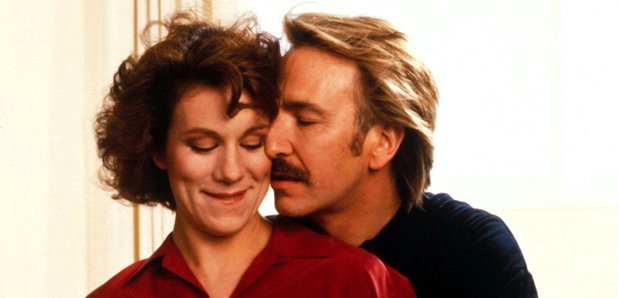
But first a brief synopsis for anyone reading this and unfamiliar with the movie.  A 1990 film, set in contemporary London, starring Juliet Stevenson as Nina and Alan Rickman as Jamie.  Nina is grieving, to the exclusion of all else in life, the death of her partner, Jamie.  Neither her therapist or concerned friends and family can bring her out of her self pitying state.  Jamie suddenly returns, as a ghost, and lives with her, which restores Nina to life.  But there are frustrations to living with a dead person, she meets a good man but is unable to commit, until she can accept it's time to say goodbye and move on.  Classic tear-jerker territory, but raised above the risk of melodrama by brilliant performances and an excellent script.  And it's often as funny as it is sad.

In one of the earliest scenes Nina is about to leave her office, but is held back by boss Sandy (Bill Paterson).  He comments on her behaviour, wants her to come for drinks with the crowd, clearly cares about her a lot.  And she shuffles out of the door, unable to explain, unable to deal with the kindness, finding sadness the easier option.  It was easy to imagine feeling the same way in those circumstances, and empathy is a powerful emotional string puller.

At her therapist Nina is in full on blub mode, tears, snot, crumpled face, angry with everyone and everything and Jamie more that anyone else.  Who could resist the power of that face?  It is where we do not want to be.  She admits to hearing his voice, constantly, telling her to get on with the mundane acts of her life, like locking the back door at night.  A presence both there and not there.  

Then Jamie comes back into her life.  She is playing piano, hears a cello accompaniment and smiles at the memory.  Except that the strings continue when the keys cease to sound.  We see Jamie in the background, and, turning round, so does Nina.  It is a moment of disbelief, of joy at reconnection, of grief at knowing that this cannot be real.  And yet it is, he is solid (albeit constantly cold) yet certainly dead.  And she can wallow in something more joyful at last.

All of these pile one on another in the first thirty minutes, but my other welling up moments come towards the end of the film.  Goodbyes and new beginnings.  The most moving moment of all (and one which has brought the tears out as I recall it) sees Jamie reciting a poem in Spanish, with Nina translating each one into English as he proceeds.  It is an excerpt from La Muerta (The Dead Woman) by the great Chilean, Pablo Neruda, and each successive line becomes harder for Nina to relate as she builds towards another flood of tears, this time in Jamie's (dead) arms.

The final lines of the verse are

"my feet will want to march

to where you are sleeping

but I shall go on living"

- my bottom lip trembled, my own tears joined Juliet's, and it was clear that this moment was pivotal, was the chance for her to finally accept the life she had, leaving the one now lost to her.

My final two moments were less dramatic, less emotionally draining, for the tears were part happiness now.  When Mark (Michael Maloney) persuades her to talk about the barrier she has put up, and shows his understanding of her situation, it feels like a release.  And the closing moments, when Mark comes to collect her from that 'terrible flat' and in the window stands Jamie, sad/happy to see her go, surrounded by his dead mates who all wave the couple off into the night.  

Letting go, accepting loss, returning to real life, are bittersweet moments in life.  My tears were for Nina and Jamie, and Mark, and all the people who have to pass through such moments in their lives - which means all of us.  And for myself, for I am incapable of watching, or reading about, such situations without imagining myself placed in them and wondering how I'd react.  As Nina and Mark and even as Jamie (except I can't play the cello...).  It's a tribute to Stevenson and the late Rickman, and to writer and director Anthony Minghella, that there were times when the emotions felt as real to me as they did to the characters.  Experiencing these moments by proxy flexes our emotional muscles without risk, reminds us what it means to be human.  That's what stories are for.


(Footnote.  I had completely  forgotten the poetry scene, and the strange coincidence it brought forth.  My final choice of weepy movie lay between TMD and Il Postino, in which one of the central characters is a fictionalised version of Neruda.)

Monday, 7 November 2016

Botanic Lights

FOLLOW THE LIGHT

The 2016 Botanic Lights show, at Edinburgh's Botanic Garden, ended last night, another sell out I believe.  If you didn't manage to make it along I took some photos and videos that will give you an idea of what you missed.

I have to admit to being dubious before we went.  Fifteen quid seemed a lot to have a cold walk around a bunch of lit up trees.  My cynicism was unfounded.  We spent ninety minutes going around and enjoyed it all.  It's a lot more than just a few lighting effects.  Although it's surprising what a bit of coloured light can do to raise the profile of even the most boring vegetation.  Click on the links to go to my YouTube Channel.


The theme of the event was Explore.


Explore the world, explore different cultures, recognise our common humanity.  The clearly laid out pathways had something to see all the way along, with several stopping off points for longer, more dramatic displays.  Light art is high tech stuff and there was a lot of imagination and skill on display.

Right from the start there's a very different feel to the place.

Just going through a section of woodland takes on a sense of the theatrical.

This box like installation was constantly changing.

In a small clearing there was a man telling anyone interested to push hard on the big foam button mounted on a plinth in the middle.  Get it right and lights shot up the tree and the bells rang, like the old funfair strength test.

That's the way to do it.

People get lit up too!


The dancing fountains were beautiful - this video's a bit longer than the others.

Walking along some pathways was like being guided by a thousand tinkerbells.


And the lantern-lit walk like  visit to China (or Habitat....).

It wasn't all about bright and flashing lights.  This structure resembled a cross between a radioactive spider's web and the cat's cradle games kids used to play with wool.

There was a tree festooned with Nepalese ribbons, and you could buy one to tie on with your own message added.


This constantly changing hedgerow was amazing, and the sheer size of it isn't really obvious on film.

I thought the coloured light pools on this path were very effective, like mosaic flooring.

The Victorian Palm House was given the stellar treatment.

This simple outline of the map of the world was repeated all the way up this wall.

The last major display on the tour was this swift tour of the world spread across a Georgian facade.  It's also the longest of these films.

But I've left my personal favourite until last, an oriental series of images displayed on to a fountain of water.  Look out for the man and his dog.

Not bad for fifteen quid really.  Better still, it didn't rain.

Monday, 3 October 2016

Turning myself into .... art?

THE ART OF NARCISSISM


I have a new project to amuse myself with over the next few weeks.  It's inspired by two recent events in my life.

The first was visiting the Facing The World exhibition at the National Portrait Gallery, my favourite amongst the city's excellent and varied art houses of art.  A collection of self portraits from Rembrandt to the present day, it was striking, intriguing and sometimes disturbing.  There were plenty of images that left an impact upon me, but two would return to mind later when the second event hit me.

It was seeing the photo above one morning.  Hillary Clinton, US Presidential Candidate, waving to a crowd.  All of whom are looking at her on tiny screens while they turn their back on one of the most famous women in the world.  Could anything exemplify what's become known as the Selfie Culture any more than this image?  A society where many people appear not to believe they've been somewhere, done something, seen someone unless they have a photograph to place themselves in the place, the action, with the person.  It's a phenomenon the likes of Nicola Sturgeon has seized on and not only accepted but used to her advantage.  It seems Clinton is going the same route.

I take photos of the place the event, the person, but I know I've been behind the lens, I don't need to place myself in the shot to prove it.  Maybe it's an age thing, but I confess to being one of those people who winces at the sight of a selfie stick.  All the time I have no good reason for doing so, other than another attitude that's stuck in the past...  Move on Crawford!

Yet the apparent narcissism of the selfie's predominance is an issue that's discussed seriously in many publications and discussions.  It's a significant cultural change, yet another arriving through new technology and the power of interconnectedness, whether deemed beneficial, detrimental or neutral.  Is it also art?   When does the selfie stop being narcissism and become art?  Or can these two things coexist?

So was Rembrandt a narcissist?  Lacking the advantages of photography artists frequently painted themselves simply for practice, to improve their technique, to experiment with lighting and poses and expressions.  Models were expensive and not always readily available.  The selfie of the time was a practical necessity for an artist seeking to improve.

But the selfie now?  The same approach can apply if you want to seriously undertake some portrait photography.  But it can be art too.  In that exhibition there was an intriguing self portrait photograph by an artist in the 1930s (I have forgotten her name, sadly).  The camera is slightly above her and to her left.  She is sat down looking relaxed, looking away to the left of the shot, one hand in her lap, the other out of the frame.  It was thought the (missing) left hand was holding the pressure bulb used to trigger the remote control to take the picture.  Nowadays our cameras have timers, making this kind of shot easier to set up.  That thirties photo, so striking in it's composition, is proof of the selfie as art.  It said as much about the subject as many of the wonderful paintings on those walls.

So how can you or I turn selfies into an art form?  Are there rules to follow?  Or is the intent that enables the transformation?  My own wee experiment is to take frequent selfies over the next couple of months and see what the results are.  To use varied lighting, poses, angles, facial expressions.  Rather than my phone I'm going 'old tech'.  Well back to 2008, before the selfie exploded into what it is today.  Nothing fancy, just a compact Canon, new enough to have reasonable pixel count and lens, old enough to be a break from the social media immediacy of the selfie as we know it today.  No photoshopping, no filters, no fancy effects.  Flash, tripod and timer are the only conveniences I'll employ.

I have no idea where this is leading me, but I'll be posting the results in December.